

♥ Wishlist
Compare 56 verified Pet Feeding Bowls and Dispensers products in India. Reviews, ratings, pros, cons and buying advice updated for October 2026.







Choosing the right feeding bowl or food dispenser for a dog or cat is about more than appearance. The material, bowl shape, capacity, stability, cleaning requirements, feeding height and dispensing mechanism can all affect everyday use. A bowl that works well for a large dog may be unsuitable for a small puppy, while a convenient automatic dispenser may not be appropriate for every feeding routine.
This independent buying guide explains the most important differences between pet feeding bowls, elevated feeders, slow feeders, water bowls, gravity dispensers and automatic food dispensers available for pet owners in India. Instead of choosing solely on ratings or price, compare the specifications with your pet's size, eating behaviour, diet and daily routine.
When comparing products, look at the complete specification rather than relying on photographs. Brands such as PetSafe, Trixie, WOPET, Amazon Basics and other established pet-product manufacturers offer different designs for different needs. Availability, seller reputation, warranty terms, replacement parts and current pricing can vary, so verify those details before purchasing.
The best feeding bowl is the one that is appropriately sized, stable, hygienic and practical for both the pet and the person responsible for cleaning it. There is no universally best bowl for every dog or cat.
Material is one of the first specifications worth checking because it influences durability, cleaning and everyday hygiene.
Capacity should be matched to the amount of food your pet normally receives, rather than simply selecting the largest bowl available. A bowl that is excessively large can be awkward for a small animal, while a very small bowl may cause food to spill over the sides.
For dry food, compare the bowl's stated volume with the size of the typical meal. Wet food may occupy a different volume for the same nutritional quantity, so capacity should not be treated as a substitute for following your veterinarian's feeding recommendations or the food manufacturer's instructions.
A lightweight bowl can slide across a smooth floor while a pet is eating. This can lead to spilled food and frustration, particularly with energetic dogs.
Depth and diameter can matter as much as capacity. A deep, narrow bowl may be inconvenient for some pets, while a broad, shallow design can make access easier for certain animals.
For cats and pets that dislike having their whiskers repeatedly touch the sides of a narrow container, a wider and shallower feeding surface may be worth considering. For dogs, the appropriate shape depends on breed, muzzle structure, eating behaviour and the type of food being served.
Standard bowls are the simplest option and are suitable for many feeding routines. Their main advantages are affordability, easy storage and straightforward cleaning. When comparing standard bowls, prioritise material quality, capacity, stability and ease of washing.
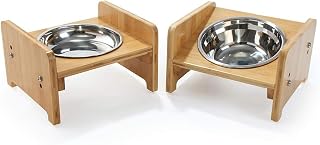
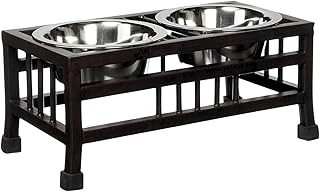
Elevated feeders place the food surface above floor level. They can be useful where a particular feeding height is more comfortable for the pet or owner, but the ideal height is not identical for every animal.
Do not select an elevated feeder solely because it looks premium. Measure the available space and consider the pet's size, bowl diameter, stand stability and whether the bowls can be removed independently for washing.
Slow feeders contain ridges, channels, patterns or raised sections that make food harder to consume rapidly. They are designed to encourage slower eating and can be useful for pets that routinely finish meals very quickly.
The pattern should be challenging without making normal eating unnecessarily frustrating. Very complicated designs can also be harder to clean, especially when wet food becomes trapped in narrow channels.
Automatic feeders can dispense measured portions according to a programmed schedule. They can be useful for owners who need more predictable feeding times or who are away from home during part of the day.
However, an automatic feeder should be viewed as a feeding-management device rather than a substitute for monitoring your pet. A scheduled dispenser cannot identify every medical problem, detect whether food was actually consumed, or replace appropriate supervision.
Gravity dispensers hold a larger quantity of dry food and allow the bowl to refill as food is consumed. Their simplicity can make them attractive for certain households.
One important consideration is portion control. If a pet tends to overeat, unrestricted access to a gravity feeder may be less suitable than a measured feeding routine.
Water products require their own evaluation because freshness, cleaning and access are particularly important. A water dispenser should be easy to disassemble and clean, and any filter or pump should have clearly defined replacement or maintenance requirements.
If you are considering an automatic feeder, look beyond the headline feature of scheduled feeding. The practical details determine whether the machine remains useful after the novelty wears off.
Check how the dispenser defines a portion. One programmed serving may not correspond to the amount you assume, and different foods can have different pellet sizes and densities.
A useful automatic feeder should make it reasonably clear how much food is released per programmed serving and how the portion can be adjusted. If precise dietary management is important, manually verify the delivered quantity before relying on the programmed schedule.
Many automatic feeders are designed primarily for dry kibble. If your pet eats wet food, semi-moist food or unusually shaped kibble, check compatibility carefully before buying.
Food size can affect whether a mechanism dispenses consistently. A feeder that works with one kibble size may not perform identically with another.
For electronic feeders, power reliability is an important consideration in India. Check whether the unit uses mains power, batteries or both. If it offers battery backup, verify what functions remain available during a power interruption.
Do not assume that a feeder will continue operating indefinitely during an outage simply because batteries are included. Read the manufacturer's specifications for the intended backup arrangement.
Some premium feeders include Wi-Fi connectivity and smartphone controls. These features can provide scheduling and monitoring conveniences, but they also introduce additional setup requirements.
A dispenser with a larger hopper can reduce the frequency of refilling, but larger capacity is not automatically better. Dry food should be stored appropriately, and the hopper should be cleaned according to the manufacturer's instructions.
Look for a lid that closes securely and a design that makes it straightforward to remove remaining food when cleaning is necessary.
Dogs vary considerably in size and eating behaviour, so a good dog bowl should be selected according to the individual animal rather than simply by breed name.
Small dogs generally benefit from appropriately scaled bowls that allow easy access without requiring excessive head movement. A heavy bowl can also be useful if the dog frequently pushes lightweight containers around.
Puppies may outgrow their first bowl quickly, so consider whether the product will remain practical as the dog develops.
Larger dogs typically require a larger feeding surface and a sufficiently stable base. Capacity should be based on the actual meal size rather than the dog's body size alone.
If you are considering an elevated feeder, measure the pet and compare those measurements with the stand's dimensions. Avoid assuming that every elevated feeder is suitable simply because it is marketed for large dogs.
A slow feeder may be worth considering for dogs that consistently consume meals at a very rapid pace. Compare the difficulty of the maze or ridge pattern, ease of cleaning and compatibility with the food being served.
Cats can be particular about feeding equipment. Bowl shape, cleanliness, location and accessibility may influence whether a cat readily uses a particular feeding station.
Wide, shallow bowls can provide easier access to food and may be preferable for cats that appear uncomfortable with narrow or deep containers. The exact preference varies by individual cat.
Cat feeding bowls should be cleaned regularly. Products with complicated grooves, decorative cavities or difficult-to-remove components can create unnecessary maintenance work.
Before purchasing, inspect the bowl for seams, crevices and areas where food residue could accumulate. A simple design that can be thoroughly washed may be more practical than a feature-heavy product.
The material comparison is one of the most useful ways to narrow down your choices.
There is no need to choose a bowl simply because a material is fashionable. The right choice depends on how often it will be washed, where it will be used, how aggressively the pet interacts with it and whether the bowl can be maintained properly.
Customer ratings can be useful, but an overall rating does not tell you whether a particular bowl suits your pet. Read the specification and consider reviews that discuss the exact issue you care about, such as stability, cleaning or dispenser reliability.
More capacity does not automatically mean better value. A large bowl can take up unnecessary space and may be inconvenient for a small pet.
A bowl can look attractive while being difficult to clean. Before buying, examine how the bowl separates from its stand, whether corners are accessible and whether electronic components can be safely kept away from water.
Programming a number of servings is not the same as knowing the exact quantity delivered. Confirm the dispenser's portion behaviour using the food you actually intend to use.
Measure the available floor or counter space. Consider nearby walls, cabinets and furniture, particularly when buying a feeder with a large hopper or an elevated stand.
Wi-Fi, cameras and mobile notifications can be useful, but they also increase complexity. If your primary need is scheduled dispensing, a simpler feeder may be easier to operate and maintain.
When creating a shortlist of ten products, use a consistent comparison framework rather than selecting products based solely on popularity.
Spending more makes sense when the additional cost solves a genuine problem. A more expensive bowl may offer heavier construction, better finishing, a more stable base or easier cleaning. A premium automatic feeder may provide more precise programming or useful monitoring functions.
On the other hand, decorative finishes, unnecessary connectivity and oversized capacities may add cost without improving your pet's everyday feeding experience.
For most buyers, the best value comes from identifying the features that address a specific need and ignoring features that are unlikely to be used.
Regular cleaning is essential for feeding equipment. Food residue can accumulate around rims, seams, stands and dispenser mechanisms, particularly when wet food is used.
Disconnect electronic equipment from power as directed before cleaning. Do not immerse electrical components unless the manufacturer specifically states that they are designed for immersion.
Inspect the dispensing path periodically for food fragments. Check the hopper, lid, seals, feeding tray and other removable components according to the manufacturer's maintenance instructions.
Replace damaged bowls or components when they develop cracks, sharp edges, significant corrosion, damaged seals or other defects that could affect safe use. For electronic feeders, investigate inconsistent dispensing, unusual noises or damaged cables rather than continuing to use a malfunctioning device without checking the manufacturer's guidance.
Indian households can have very different living arrangements, from compact apartments to larger homes with outdoor feeding areas. The best feeding product should fit the actual environment in which it will be used.
Compact bowls, stackable designs and feeders with manageable footprints can be useful where floor space is limited. Noise may also matter if an automatic feeder is placed close to sleeping or living areas.
Multiple pets can make feeding management more complicated. Individual bowls may help owners monitor each animal's food intake, while automatic feeders can be useful when different schedules or portions are required.
However, a dispenser should not be purchased solely because it has a large hopper. Consider whether each pet can access the feeder without interference from another animal.
Collapsible silicone bowls can be convenient for travel because they take up less space. For longer journeys, consider durability, cleaning access and how securely the bowl can be stored between uses.
Outdoor feeding areas expose bowls to dust, moisture, insects and temperature changes. A stable, easy-to-clean bowl may be preferable to a lightweight product that can be easily overturned.
Manual feeding remains the simplest option for many households. It provides direct control over every meal and does not depend on batteries, motors, applications or programming.
An automatic feeder can be more convenient when consistent schedules are difficult to maintain. It may also help divide a daily food allowance into multiple programmed meals, depending on the product.
The choice should therefore be based on the household's routine rather than assuming automatic technology is inherently superior.
Customer reviews are most useful when they are treated as supplementary evidence rather than a substitute for specifications. Look for patterns across multiple reviews.
For bowls, recurring comments about slipping, rusting, cracking, staining, difficult cleaning or inaccurate dimensions may be more informative than a single positive comment.
For automatic feeders, pay attention to recurring comments about dispensing consistency, connectivity, power interruptions, motor noise, food jams and cleaning. Also check the date of reviews because product revisions can change the experience over time.
Established names such as PetSafe, Trixie, WOPET and Amazon Basics may appear across different pet-feeding categories, but brand recognition should not replace product-level comparison. A brand can offer several products with very different specifications.
For marketplace purchases, compare the exact model number, seller information, included accessories, warranty terms and return conditions. Product photographs can sometimes represent a similar-looking variant, so the written specification should receive greater attention.
Before purchasing, check the current listing details because prices, sellers, stock status, bundled accessories and delivery availability can change.
A good long-term purchase should be easy to use every day, straightforward to clean and appropriately sized for the pet. For electronic feeders, reliability and maintainability are especially important because a sophisticated feature set has limited value if the owner finds the device difficult to operate.
Durability should also be considered in terms of replaceable parts. A feeder that allows commonly worn components to be replaced can potentially remain useful longer than a product that must be discarded after a minor component fails.
Automatic feeding technology can improve routine management, but it should not be treated as a complete substitute for checking on a pet. Owners should still monitor food intake, water access, general behaviour and the condition of feeding equipment.
If a pet suddenly stops eating, eats substantially more or less than usual, repeatedly vomits, develops difficulty eating or shows another concerning change, feeding equipment alone should not be used to diagnose the problem. Seek appropriate veterinary advice when health concerns arise.
There is no single best type for every pet. Stainless steel bowls are a practical choice for many households because they are durable and relatively easy to clean. Ceramic can provide additional weight and stability, while plastic and silicone can be useful in specific situations. The correct choice depends on the pet, feeding routine and intended environment.
Stainless steel is often preferred when durability and easy cleaning are priorities. Plastic can still be useful when low weight and affordability are important. Compare the actual construction, finish and cleaning requirements rather than selecting solely according to material.
Elevated bowls can be useful in some feeding setups, but they are not automatically better for every dog. Consider the dog's size, feeding posture, stability of the stand and any specific advice provided by a veterinary professional.
No. Slow feeders are designed for dogs that benefit from a slower eating pace, but the difficulty level should be appropriate. Choose a design that can be cleaned thoroughly and does not make normal feeding unnecessarily difficult.
An automatic feeder can be worthwhile when scheduled feeding is genuinely useful for your household. It is less compelling if the main requirement is simply a basic bowl. Compare portion accuracy, food compatibility, power backup, cleaning and reliability before paying extra for smart features.
Some products are designed for wet food, while many are intended primarily for dry kibble. Always check the manufacturer's specifications for food compatibility, storage duration and cleaning requirements before using wet food in an automatic dispenser.
Feeding bowls should be cleaned regularly rather than allowing food residue to accumulate. The appropriate routine depends on the food type and the manufacturer's instructions. Wet food generally requires more immediate cleaning than dry kibble.
Select a bowl based on the dog's normal meal size and physical access to the food. The bowl should provide enough room for the meal without being unnecessarily large or deep. Always compare the stated dimensions and capacity rather than relying on a generic small, medium or large label.
Consider a stable, easy-to-clean bowl with an appropriate diameter and depth. Some cats may prefer wider, shallower feeding surfaces. Individual preference matters, so observe how your cat interacts with the current bowl before changing it.
Gravity feeders can be convenient for pets that are suitable for free access to dry food. They may be less appropriate for animals that need carefully controlled portions. Consider the pet's eating behaviour before choosing one.
Choose a conventional bowl when simplicity and direct feeding control are your priorities. Choose a dispenser when scheduled or automated portions provide a meaningful benefit to your routine. A dispenser is not necessarily a better feeding solution simply because it has more technology.
A useful product comparison should consider more than star ratings. For this category, the most relevant criteria include construction, capacity, dimensions, stability, cleaning, food compatibility, dispensing performance, power requirements and long-term practicality.
Because product specifications, sellers, prices and availability can change, verify the current information before buying. Treat customer reviews as additional evidence and look for recurring patterns rather than relying on isolated comments.
The right pet feeding product is ultimately the one that fits the animal, the feeding routine and the household. A simple high-quality bowl can be a better choice than an unnecessarily complicated dispenser, while a reliable automatic feeder can be valuable when scheduled feeding solves a genuine everyday problem.
When comparing the best pet feeding bowls and dispensers in India in 2026, start with your pet's needs rather than the product's feature list. Prioritise appropriate size, safe and practical construction, stability and easy cleaning. If you are considering an automatic model, give additional attention to portion control, food compatibility, power backup, maintenance and replacement parts.
Before making a final purchase, compare the exact specifications, current customer feedback, warranty information and current seller details. This approach makes it easier to identify genuine value and avoid paying more for features that do not improve your pet's daily feeding routine.