

♥ Wishlist
Compare 60 verified Baby Feeding Products, Bottles, Sterilisers & High Chairs products in India. Reviews, ratings, pros, cons and buying advice updated for October 2026.










Choosing baby feeding products is not simply a matter of selecting the highest-rated bottle, the largest sterilizer or the most feature-rich high chair. Feeding equipment has different jobs at different stages, and the right choice depends on the baby's age, feeding method, daily routine, cleaning requirements, available kitchen space and the preferences of the parent or caregiver.
This guide covers the major categories commonly included in a baby-feeding setup in India: feeding bottles, bottle nipples and accessories, sterilizers, bottle warmers, cleaning equipment, bibs and feeding accessories, suction bowls and spoons, and high chairs. Instead of treating every product as interchangeable, compare the specifications that actually affect everyday use.
Product availability, specifications, colours, pack sizes and prices can change during 2026. Before purchasing, check the current product listing, manufacturer's instructions, age guidance and safety information supplied with the product.
Baby bottles are commonly available in materials such as polypropylene, other food-contact plastics, glass and silicone-based components. Each material involves practical trade-offs.
Plastic bottles are generally valued for their lighter weight and everyday convenience. Glass bottles can appeal to parents who prefer a rigid, reusable material and are comfortable with the additional weight and handling considerations. Silicone components can be useful for specific bottle designs, but the complete feeding system should be evaluated rather than judging a bottle by one material alone.
Look for clear information about the material used for the bottle, nipple, collar, cap and any internal valve. A product can contain several different materials, so a description that mentions only the main bottle material may not tell you everything you need to know.
Capacity should match the baby's feeding stage and the way bottles are used at home. Smaller bottles can be convenient for early feeds and may be easier to handle, while larger bottles can reduce the number of refills for older babies who require larger feeds.
Buying several bottles of the same size is not always the most efficient approach. A mixed set can be useful when the household uses different quantities at different times of the day. Consider how many feeds need to be prepared between washing cycles before deciding how many bottles to purchase.
A bottle that looks simple can still be difficult to clean if it has narrow openings, deep internal sections or several detachable parts. Wide-neck designs may provide easier access for cleaning, while certain shapes may be easier for a caregiver to grip.
Do not assume that a particular neck shape automatically prevents feeding problems. Bottle compatibility depends on the complete system, including the nipple and any internal components.
Many feeding bottles use vents, valves or specialized nipple designs intended to influence how air moves during feeding. These systems can add components that require careful assembly and cleaning.
When comparing an anti-colic bottle, examine how the system works, how many parts must be cleaned and whether replacement components are available. A technically sophisticated design is less useful if caregivers find it difficult to assemble correctly or maintain consistently.
The nipple is one of the most important components of a feeding bottle because its flow characteristics directly affect how milk or formula is delivered. Nipple designs commonly differ by shape, material and flow rate.
Nipples may be categorized by stages such as slow, medium or faster flow, although naming systems vary between manufacturers. Age labels should be treated as guidance rather than a substitute for observing the baby's feeding behaviour.
A nipple that is too fast can make feeding difficult for some babies, while a flow that is too slow may frustrate others. Follow the manufacturer's guidance and, when feeding concerns arise, consult an appropriately qualified pediatric professional rather than modifying a nipple yourself.
Silicone nipples are widely used because they are flexible and available in many feeding systems. The exact feel, firmness and shape vary considerably between products. When replacing a nipple, check that the replacement is designed for the specific bottle system.
Replacement availability is an important buying criterion that is easy to overlook. Before committing to a bottle system, check whether replacement nipples are sold separately and whether different flow stages are offered.
A bottle with inexpensive initial pricing can become less convenient if its compatible replacement components are difficult to source. Conversely, buying large quantities of replacement parts before knowing which feeding system works for your household can lead to unnecessary expense.
Cleaning is one of the most important practical considerations when selecting feeding equipment. Bottles, nipples, caps, rings, valves and other components should be cleaned according to the manufacturer's instructions.
Products with many small components can require more careful cleaning because milk or formula can remain in seams, valves or narrow passages. Before buying, look at the complete disassembly process and ask whether every component can be reached easily during washing.
A good bottle-cleaning setup should accommodate the bottle shape and nipple design. Some households use a dedicated bottle brush together with smaller brushes for nipples, valves or narrow components.
The brush itself should also be easy to clean and dry. A brush that remains damp between uses may become an additional hygiene concern, so storage and drying should be considered alongside the brush's cleaning performance.
A dedicated drying rack can separate freshly washed feeding equipment from other kitchen utensils. When comparing racks, look at the spacing between supports, the stability of the base, drainage design and the amount of counter space required.
A compact rack may suit a small kitchen, while a larger household may prefer a design capable of holding several bottles and accessories simultaneously. The best size is the one that matches the number of components normally washed at one time.
A bottle sterilizer can make a regular feeding routine more organized, but the most useful model depends on the household's cleaning method, bottle quantity and available space.
Electric steam sterilizers use heat and steam according to the manufacturer's operating cycle. Their main attraction is convenience for households that regularly process multiple feeding components.
When comparing models, examine the internal layout rather than relying solely on the stated bottle capacity. A sterilizer advertised for a certain number of bottles may accommodate different bottle shapes and accessories in different ways.
Microwave sterilizers generally consist of a container designed to hold feeding equipment while using microwave-generated heat and steam according to specific instructions.
Compatibility with the household microwave is important. Check the sterilizer's dimensions, operating instructions and any stated microwave requirements before purchase. Never assume that a generic microwave setting is appropriate; follow the instructions supplied for the specific product.
Portable sterilizing solutions can be useful when travelling or when counter space is limited. Their suitability depends on the manufacturer's instructions, permitted number of uses where applicable and the equipment available at the destination.
For frequent home use, compare the ongoing convenience and component capacity against a reusable sterilizing system.
Capacity should be measured in terms of the complete feeding routine rather than the number printed on the product box.
A bottle warmer can be convenient for caregivers who regularly need to warm expressed milk or prepared feeds. The important comparison points include heating method, temperature controls, compatibility with different bottle shapes and the manufacturer's instructions for the type of feed being warmed.
Heating performance should not be judged only by a single advertised heating time because starting temperature, bottle material, bottle volume and the warming method can all affect the result.
Do not rely solely on an appliance's temperature display. Follow appropriate feeding and food-safety guidance for the specific milk or formula being used, and check the feed before giving it to the baby.
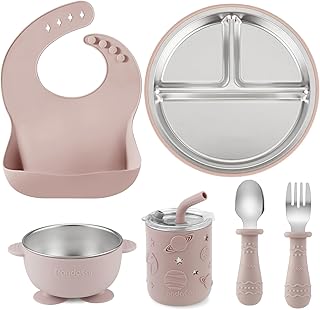
Bibs are simple but useful for reducing the amount of food and liquid that reaches clothing during feeding. Compare absorbency, coverage, fastening design, cleaning requirements and drying time.
For early spoon feeding, a bib with wider coverage can be practical. For independent eating, easy-clean surfaces may become more valuable than absorbency alone.
Feeding spoons should be appropriately sized for a baby's mouth and comfortable for the caregiver to control. Look for smooth edges, an easy-to-clean design and material information suitable for food contact.
Very deep spoon bowls can make early feeding less convenient, while a shallow bowl may be easier for transferring small amounts of food. The appropriate choice depends on the baby's developmental stage and feeding approach.
Suction bases can reduce movement on suitable smooth surfaces, which may help when a baby begins practising self-feeding. However, suction performance depends on the surface, moisture and the specific design.
Do not assume that a suction base makes a bowl impossible to move. Supervision remains important during feeding, especially when a child is learning to handle food and utensils independently.
When storing prepared baby food, prioritize clear material information, secure closures, appropriate capacity and easy cleaning. Containers should be used according to their stated temperature and storage limitations.
A high chair is a larger purchase than a spoon or bib, and its design can affect daily feeding routines for a long time. Stability, restraint, cleaning and suitability for the baby's developmental stage should therefore take priority over decorative features.
A stable base is fundamental. Look at the footprint, leg configuration, weight distribution and whether the manufacturer's instructions specify particular requirements for safe use.
A lightweight chair may be convenient to move, but low weight should not be treated as a sign of quality or poor quality by itself. Stability depends on the complete construction and how the chair is used.
A suitable restraint system is an important consideration for a high chair. Compare the harness configuration, adjustment mechanism and manufacturer's instructions for securing the child.
Never rely on the tray as a substitute for a restraint system. Follow the product's safety instructions and use the chair only for the intended age and developmental stage.
Comfort and positioning matter during feeding. Some high chairs provide adjustable footrests or other ways of adapting the seating position as the child grows.
When comparing models, examine whether the foot support is appropriately positioned and whether adjustments can be made securely. A chair with numerous adjustment points is not necessarily better if those adjustments are difficult to operate correctly.
A removable tray can make cleaning easier and may simplify placing the child in or taking the child out of the chair. Check whether the tray has multiple positions and whether the attachment mechanism is straightforward.
Pay particular attention to seams, corners and joints where food can collect. A tray that looks attractive but has difficult-to-clean recesses may create additional maintenance work.
Feeding can be messy, so cleanability should be treated as a core feature rather than an afterthought. Plastic surfaces are generally easier to wipe, while padded seats may provide additional comfort but can require more care.
Compare the seat cover, harness straps, tray surface, frame joints and wheels or adjustment points. These areas often require different cleaning methods.
Before buying, check whether the cover is removable, whether it can be washed according to the manufacturer's instructions and whether replacement covers or components are available.
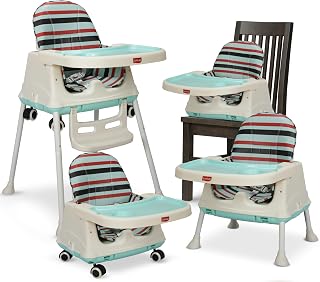
Foldability can be valuable in Indian homes where storage space is limited. A compact folded footprint can make a substantial difference in a smaller kitchen or dining area.
However, folding mechanisms introduce additional hinges and joints. Compare how easily the chair folds, whether the locking mechanism is clear and whether food can accumulate around moving parts.
A full-size chair may be preferable where storage space is not a concern and the chair will remain in a dedicated feeding area. The best format depends on the available space and how frequently the chair needs to be moved.
Convertible models can change configuration as the child grows, potentially extending the useful life of the product. When evaluating one, look beyond the number of configurations advertised.
Material selection should be considered together with cleaning instructions, intended use and durability. Terms such as food-grade, BPA-free or silicone describe particular aspects of a product and should not be interpreted as proof that a product is automatically suitable for every use.
Read the manufacturer's material information for the complete product, including accessories that contact food or milk. Also check whether components are suitable for boiling, steam sterilization, dishwasher cleaning, microwave use or freezing before using those methods.
Parents often encounter material claims while comparing feeding bottles and accessories. A BPA-free claim addresses the absence of bisphenol A in the relevant material, but it does not by itself describe every property of the product.
For a meaningful comparison, consider the material specification, intended application, temperature limits, cleaning instructions and compliance information provided by the manufacturer.
Glass and plastic are both used in baby feeding systems, but they suit different priorities.
Maintenance is often more important than an impressive feature list. A feeding product that is used several times a day should be easy to disassemble, clean, inspect and dry.
Ratings can help identify products worth investigating, but a rating does not reveal whether a bottle fits your feeding routine or whether a high chair fits your kitchen. Read the specifications and recurring customer comments before making a decision.
Nipples, valves, seals and other small components can require replacement or may eventually become damaged or worn. Check the availability and compatibility of replacement parts before choosing a particular feeding system.
A large capacity can be useful, but a larger appliance also takes more counter and storage space. If the household uses only a few bottles, an oversized sterilizer may add unnecessary bulk.
Colour and design can influence a purchase, but stability, restraints, cleaning access, dimensions and suitability for the child's developmental stage deserve greater attention.
Measure the area where a sterilizer, drying rack or high chair will actually be used. Include space needed to open lids, remove trays and access controls.
Bottles, nipples, valves, sterilizers and warmers are not necessarily interchangeable. Check compatibility carefully before mixing products from different systems.
A simple comparison framework can prevent feature overload. Start with the essential function, then compare usability, cleaning, compatibility and long-term ownership.
Well-known baby-care brands can be useful starting points when comparing feeding systems, but brand recognition should not replace product-level evaluation. Depending on the category, Indian shoppers may encounter brands such as Philips Avent, Dr. Brown's, Pigeon, Chicco, Tommee Tippee, Mee Mee, R for Rabbit, LuvLap, MAM and Babyhug.
Brand ranges can differ significantly by product category, and the specifications of one bottle or high chair should not automatically be applied to every product from the same company. Compare the exact model, included components, age guidance, cleaning instructions and replacement-part ecosystem.
Philips Avent is a widely recognized baby-care brand with products spanning bottles, nipples and other feeding accessories. When evaluating a Philips Avent product, compare the specific bottle or accessory design rather than relying on the brand name alone.
Dr. Brown's is particularly associated with bottle systems that use internal venting components. These systems can appeal to parents looking for a specialized bottle design, but the additional parts make cleaning and correct assembly important comparison points.
Pigeon offers baby feeding products including bottles and nipples. When comparing its feeding systems with alternatives, pay attention to nipple design, flow stage, bottle capacity, material and compatibility with replacement components.
Chicco has a broad baby-care range that includes feeding products. Individual models should be assessed according to their construction, age guidance, cleaning requirements and intended use rather than the general reputation of the brand.
Tommee Tippee is another established baby-feeding brand with bottle and feeding accessories. Compare the exact bottle system, nipple options, components and replacement availability when considering it alongside other brands.
Indian shoppers may also find feeding products from brands such as Mee Mee, R for Rabbit, LuvLap and Babyhug across different categories. These brands cover varying product designs and price segments, so product-level specifications remain the most useful basis for comparison.
Customer reviews are most useful when they reveal recurring practical experiences rather than isolated opinions. Look for patterns involving leakage, cleaning difficulty, durability, assembly, compatibility, storage and actual dimensions.
The purchase price is only one part of the cost of a baby feeding system. Bottles may require replacement nipples, sterilizers may require specific accessories, and high chairs may eventually need replacement trays, covers or other components.
Before buying, identify the parts that are expected to be replaced during normal use. Then compare the cost and availability of those components across competing products. A slightly more expensive initial product can sometimes be more practical if its essential replacement parts are easier to source, while an inexpensive product may not remain economical if compatible components are difficult to find.
Space can be a significant consideration in Indian homes, particularly when the kitchen counter also needs to accommodate other appliances and daily cooking equipment.
Travelling with feeding equipment requires a different set of priorities. Compact size, reliable closures, easy cleaning and compatibility with the available facilities may matter more than maximum capacity.
For travel, consider how bottles will be cleaned and dried, how many feeding components are realistically required and whether the chosen equipment can be safely used at the destination. Portable products should never be used outside their stated operating conditions.
A practical starter setup does not need every available accessory. The core equipment should match the baby's feeding method and the household's routine.
High chairs should be selected according to the child's developmental readiness and the manufacturer's stated suitability, not simply because a particular age has been reached. Look for the manufacturer's requirements concerning sitting ability, head and trunk control and permitted use.
Once the child begins using a high chair, always follow the manufacturer's instructions for restraints, positioning and supervision.
Baby feeding products require careful use because infants and young children have different safety needs from adults. Always read the instructions supplied with the specific product and observe age, weight and developmental restrictions.
A consistent maintenance routine can help extend the useful life of feeding equipment while keeping the equipment easier to inspect.
Disassemble the bottle according to its instructions, rinse or wash the components as appropriate, clean the internal surfaces and allow the parts to dry properly. Pay special attention to nipples, valves and seals where residue can remain.
Check nipples for changes in condition and inspect bottles for cracks, scratches, cloudiness, deformation or other signs of damage. Examine seals, valves and bottle collars for wear as well.
Remove food debris promptly and clean the tray, seat, harness area and accessible frame surfaces according to the manufacturer's instructions. Inspect joints and crevices because food can accumulate in areas that are not immediately visible.
Higher spending is most defensible when it solves a recurring problem or provides a meaningful improvement in safety, usability, cleaning or durability.
For bottles, additional spending may make sense when the design is better suited to the baby's feeding needs or when replacement components are easier to manage. For sterilizers, convenience and capacity can justify a higher price if the appliance will be used frequently. For high chairs, construction quality, stability, restraints, adjustability and cleanability are more meaningful reasons to spend more than decorative features.
Simple feeding accessories do not necessarily need advanced features. Basic bibs, spoons, brushes and storage containers can provide excellent practical value when their materials, construction and cleaning requirements are appropriate.
For budget-conscious households, prioritize products that are used frequently and directly affect feeding or cleaning. Avoid purchasing large bundles simply because they contain many accessories that may not be needed.
Start by separating the purchase into categories. Comparing a sterilizer against a bottle is not meaningful because they solve different problems.
When comparing shortlisted products, use the same criteria for every model. This prevents a long specification list from making one product appear better simply because it has more advertised features.
There is no single best baby feeding product for every family. The appropriate choice depends on the baby's age and feeding method, the caregiver's routine, cleaning preferences, available kitchen space and budget. Compare the exact specifications and safety instructions of shortlisted products before purchasing.
A suitable newborn bottle should be compatible with the baby's feeding requirements and have an appropriate nipple flow according to the manufacturer's guidance. Bottle size, nipple design, ease of cleaning and compatibility with replacement nipples are important comparison factors.
Neither material is universally better. Glass can appeal to parents who prefer a rigid bottle material, while plastic can offer lighter handling. Compare the exact material specification, weight, durability, cleaning instructions and intended use.
Not necessarily. Price can reflect design complexity, materials, included accessories or brand positioning, but a higher price does not automatically mean the bottle is better suited to a particular baby. Focus on feeding compatibility, cleaning, replacement parts and practical usability.
The usefulness of a sterilizer depends on the household's feeding routine and the cleaning and sterilization guidance applicable to the baby's circumstances. If you use one, select a method and appliance that can accommodate the equipment you actually use and follow its operating instructions.
They serve a similar general purpose but have different practical requirements. Electric steam models can provide a dedicated appliance, while microwave systems may appeal to households prioritizing compact storage. Compare capacity, operating requirements, available space and compatibility with your feeding equipment.
The number depends on how frequently the baby feeds, how often bottles can be washed and whether feeding equipment is needed outside the home. Instead of buying a large quantity immediately, calculate how many clean bottles are required between normal washing cycles.
Prioritize developmental suitability, stability, an appropriate restraint system, easy cleaning, suitable dimensions and a secure seating configuration. Adjustable features can be useful, but they should not come at the expense of straightforward operation and maintenance.
A foldable high chair can be particularly useful when storage space is limited. However, compare its folded dimensions, locking mechanism, stability and cleaning requirements against a fixed-format model before deciding.
They can be worthwhile when the different configurations genuinely match the child's changing needs and remain easy to use safely. Check the age or developmental guidance for each mode and consider the complexity of converting between configurations.
Replacement timing varies by material, product design, usage and manufacturer guidance. Inspect nipples regularly and replace them when they show damage, deterioration or other signs that they should no longer be used. Follow the specific manufacturer's replacement recommendations.
No. Different bottles and components can have different temperature and cleaning limitations. Always check the manufacturer's instructions before using boiling water, steam, a microwave, a dishwasher or another sterilization method.
Compatibility should never be assumed. Bottle neck dimensions, nipple collars, seals and venting systems can differ between products. Use components identified by the manufacturer as compatible with the particular bottle.
Check the exact model name, material information, capacity, dimensions, age guidance, included accessories, compatibility, cleaning instructions and replacement-part availability. Also compare current customer feedback and verify that the product listing corresponds to the model you intend to purchase.
The strongest baby-feeding purchase is usually the one that fits the family's real routine rather than the one with the longest feature list. Start with the baby's developmental stage and feeding method, then consider cleaning, storage, compatibility and long-term maintenance.
For bottles, pay particular attention to nipple flow, material, capacity, venting design and replacement components. For sterilizers, compare actual usable capacity, operating method, accessory compatibility and counter space. For high chairs, put stability, restraints, developmental suitability and cleanability ahead of appearance.
Before making a final purchase, compare the exact model specifications, current customer feedback and applicable manufacturer instructions. Product prices and availability can change, so verify today's information before ordering. A careful comparison of the complete feeding system can be more valuable than choosing individual products solely because they are highly rated or heavily marketed.