

♥ Wishlist
Compare 140 verified Buy Microwave Ovens Online in India products in India. Reviews, ratings, pros, cons and buying advice updated for October 2026.


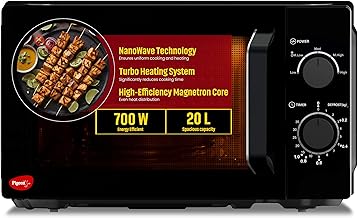


Choosing a microwave oven in India is less about finding the appliance with the longest feature list and more about matching the oven type, capacity, power, cooking modes and controls to the way your household actually cooks. A compact solo microwave can be ideal for reheating and basic cooking, while a convection model is considerably more versatile for households that also want baking, roasting and grilling functions.
For an informed purchase, compare the complete specification rather than relying only on star ratings or the number of preset menus. Capacity, usable cooking space, microwave output, heating modes, cavity construction, control layout, safety features, warranty terms and availability of authorised service should all form part of the decision.
Solo microwave ovens are designed primarily for straightforward microwave cooking, reheating and defrosting. They generally have fewer cooking functions than grill or convection models, which can make them easier to operate for everyday tasks.
Grill models add a grilling element to standard microwave functionality. This makes them useful when you want additional browning or grilling capability without moving to a full convection appliance.
When comparing grill models, examine whether the included grill rack and accessories are appropriate for the intended cooking methods. Also check the manufacturer's instructions for which containers and utensils can be used with microwave and grill modes.
Convection microwave ovens combine microwave heating with hot-air circulation. Depending on the model, they can support baking, roasting, grilling, reheating and conventional microwave cooking. They are therefore often considered by buyers who want one appliance to perform several kitchen functions.
However, additional functionality does not automatically make a convection microwave the better purchase. If your primary requirement is reheating food and occasionally cooking simple dishes, the extra modes may provide little practical benefit. A convection model makes more sense when you will actually use its broader cooking capabilities.
Capacity should be considered alongside the dimensions of the dishes you normally use. A larger stated capacity does not necessarily mean every large container will fit comfortably, because the shape of the cavity, turntable arrangement and available vertical clearance also matter.
Smaller microwave ovens can suit individuals, couples and kitchens where counter space is limited. They can be particularly practical when the appliance is mainly used for reheating, beverages and modest portions.
Medium-capacity ovens provide a useful balance between internal space and countertop footprint. They are worth considering for many small-to-medium Indian households that regularly reheat meals and prepare microwave-based recipes.
Larger models can be more convenient for families and for users who regularly cook bigger portions or use larger microwave-safe dishes. Before selecting one, measure the intended installation area and leave the ventilation clearance specified by the manufacturer.
Do not choose capacity solely by household size. A couple who regularly prepares large baking dishes may need more internal space than a larger household that primarily reheats individual portions.
Microwave power affects how quickly energy is delivered to food, but the highest wattage is not automatically the best choice. Cooking performance also depends on food quantity, moisture content, starting temperature, container shape, cooking mode and the oven's control system.
When comparing specifications, distinguish between input power and microwave output power where the manufacturer provides both. Output power is more directly relevant to microwave heating performance.
Automatic menus can simplify common cooking tasks by providing predefined time and power combinations. They are convenient, but buyers should not treat the number of menus as a direct measure of overall appliance quality.
A dedicated defrost program can make frozen food preparation easier. Look for controls that allow appropriate adjustment based on food weight or time where supported by the model.
Multiple power settings provide greater control than a simple high-power operation. This is particularly useful for reheating foods that can dry out or overheat easily.
Clear controls make a difference in everyday use. Before buying, consider whether the display is easy to read, whether buttons or touch controls are intuitive, and whether the interface can be operated without repeatedly consulting the manual.
A child lock can help prevent unintended operation. Families with young children should check exactly how the lock is activated and whether it applies to the controls in the way they expect.
Some microwave ovens allow more than one cooking stage to be programmed in sequence. This can be useful for recipes that require different power levels or a combination of defrosting and cooking.
A clear interior light makes it easier to monitor food without opening the door. This is a small feature, but it can improve everyday convenience.
A rotating turntable can promote more even exposure to microwave energy. Check the turntable diameter if you frequently use large plates or containers, and consider how easily it can be removed for cleaning.
Buyers considering convection models should look beyond the word “convection” and examine the actual cooking controls. Temperature adjustment, available cooking modes, preheating functionality, grill operation and supplied accessories can differ substantially between models.
If baking is important, check the manufacturer's guidance for suitable bakeware, recommended rack positions, preheating requirements and temperature ranges. Microwave-convection appliances are versatile, but their operation is not identical to that of a dedicated built-in or countertop conventional oven.
Coated cavities are common and can be practical for everyday cooking. Their long-term condition depends heavily on correct cleaning and avoiding damage to the interior surface.
Stainless-steel cavity construction can appeal to buyers looking for a robust interior surface. However, cavity material should be assessed alongside cleaning requirements, construction quality and the manufacturer's maintenance instructions.
Regardless of material, avoid abrasive cleaning methods that can damage the interior coating or surface. Do not operate a microwave when its cavity, door or seals appear damaged.
The door is one of the most important safety-related components of a microwave oven. Before purchasing or installing an appliance, inspect the manufacturer's safety instructions and make sure the model can be installed with the required clearances.
Cookware compatibility is sometimes overlooked when buying a microwave. Microwave-safe does not mean every item is suitable for every operating mode. A container that is acceptable for microwave heating may not be appropriate for grill or convection operation.
Always follow the manufacturer's cookware guidance. Avoid metal objects during microwave operation unless the manufacturer explicitly permits a particular accessory or configuration. Be particularly careful with metallic trims, foil, sealed containers and materials that can become excessively hot.
Before ordering a microwave oven, measure the available counter or cabinet space rather than relying on a photograph. Record the width, depth and height of the available area and compare these measurements with the manufacturer's appliance dimensions and required ventilation clearance.
Do not place a countertop microwave into an enclosed cabinet unless the manufacturer specifically states that the installation is permitted. Adequate ventilation is important for safe operation and appliance performance.
Also consider the location of the electrical outlet. Avoid stretching power cables across hot surfaces, placing the appliance where the door cannot open fully, or creating an arrangement that makes cleaning and ventilation difficult.
Established appliance brands can provide a useful starting point for comparison because buyers can examine model specifications, service information and warranty conditions through official channels. Brands commonly encountered in the Indian microwave market include LG, Samsung, IFB, Panasonic, Whirlpool, Godrej and Haier.
Brand reputation should not replace model-level comparison. A particular microwave can be a better fit for your requirements because of its capacity, controls, cooking modes or dimensions even when another brand has a stronger overall market presence.
When comparing major brands, avoid making the decision solely on brand recognition. Compare equivalent models on capacity, microwave output, cooking modes, convection temperature controls, warranty coverage, service availability, accessories and physical dimensions.
For any brand, verify the latest specifications on the manufacturer's product documentation because model numbers can have different configurations and features.
A large appliance can waste valuable counter space if you rarely use its additional capacity. Select the internal space you genuinely need and confirm that your common cookware fits.
If your usage consists almost entirely of reheating and basic microwave cooking, paying for advanced cooking modes may not provide meaningful value.
An oven can have an appropriate internal capacity yet still be unsuitable for your kitchen because of its external footprint or ventilation requirements.
Maximum power is only one part of performance. Control over power levels, cooking modes and practical usability can be equally important.
Read the warranty conditions for the exact model and check the manufacturer's current service information for your area. Warranty coverage can differ by product category and terms.
Customer reviews can reveal recurring usability concerns, but review quantity does not establish that a particular model is right for your household. Look for patterns in recent verified-purchase feedback and compare those observations with the manufacturer's specifications.
Reviews are most useful when they are treated as supplementary evidence rather than as a substitute for specifications. Look for recurring comments about door operation, control usability, noise, cleaning, heating consistency, installation and long-term reliability.
A microwave oven's electricity consumption depends on its power rating, cooking duration and the functions being used. Convection and grill operation can involve different heating elements and therefore should not be treated as identical to ordinary microwave reheating.
For a rough household comparison, examine the appliance's rated electrical input and estimate usage from your typical cooking duration. Actual consumption will vary according to operating mode and duty cycle, so a specification should be used as a comparison point rather than as a promise of a particular monthly electricity bill.
Regular cleaning helps prevent accumulated food residue and unpleasant odours. Allow the appliance to cool where appropriate, disconnect it when the manufacturer's cleaning instructions require this, and use only cleaning methods recommended for the specific model.
Age alone does not determine whether a microwave should be replaced. More important considerations include safe door operation, physical condition, recurring faults, reliability, availability of authorised service and whether the appliance still meets your cooking requirements.
If the door, hinges, latches, seals or cavity have visible damage, discontinue use and consult the manufacturer's service guidance. Do not continue operating an appliance simply because it still appears to heat food.
A useful comparison should place models on a consistent set of criteria. The best microwave for one household may not be the best for another, so a ranking should be interpreted according to intended use.
Prioritise simple controls, suitable capacity, reliable everyday operation and useful power-level settings. Advanced baking features are unnecessary if reheating is the main purpose.
Focus on external dimensions as well as capacity. A compact appliance that fits comfortably with adequate ventilation is generally more practical than a larger model that dominates the available workspace.
Look for sufficient cavity space, useful automatic programs, convenient controls and a turntable or internal arrangement that accommodates the dishes your household commonly uses.
A convection microwave is the category worth investigating. Compare temperature control, preheating, convection modes, grill capability and accessories instead of assuming every convection model provides identical performance.
Consider a model that combines microwave, grill and convection functions when you genuinely expect to use those modes. Check how easily the appliance switches between cooking methods and whether the included accessories support your intended recipes.
Compare the same model across reputable retailers rather than judging value from a single listing. Check the exact model number, included accessories, warranty terms and seller information before comparing prices.
Seasonal promotions can change the effective purchase price, but a discount should not encourage you to buy an unsuitable oven. A less expensive model that lacks a required function can represent poorer value than a moderately more expensive model that matches your actual cooking needs.
Before completing a purchase, verify the latest product specifications, current price, delivery conditions, installation requirements and warranty information from the retailer and manufacturer. These details can change over time.
Microwave ovens should be used according to the manufacturer's instructions. Never assume that cookware, containers or cooking methods that work in one appliance are automatically appropriate for another.
Before selecting one of the best microwave ovens in India, narrow your shortlist using practical requirements rather than marketing claims. The right model should fit your kitchen, accommodate your normal cookware, provide the cooking functions you will actually use and have clear warranty and service information.
There is no single best type for every household. Solo models are appropriate for basic microwave cooking and reheating, grill models add grilling functionality, and convection models provide broader cooking capabilities including baking and roasting. Select the type according to how you actually intend to use the appliance.
Not necessarily. A convection microwave offers more cooking functions, but a solo microwave can be the more sensible choice when reheating and basic microwave cooking are the main requirements. Additional features are valuable only when they are useful to you.
Choose capacity according to your usual portion sizes and cookware. Household size is a useful starting point, but the dishes you use regularly are a more practical measurement. Check the internal dimensions and turntable size where those specifications are provided.
Rather than selecting solely by maximum wattage, compare microwave output, power-level controls and cooking requirements. The appropriate power depends on the foods and quantities you prepare.
Baking capability depends on the oven type. Convection microwave ovens are designed to provide a convection cooking mode, whereas solo microwave ovens are not equivalent to conventional ovens for baking. Always follow the specific model's instructions for baking.
Microwave ovens are designed to operate safely when used and maintained according to the manufacturer's instructions. Do not use an appliance with a damaged door or sealing components, and use only cookware appropriate for the selected cooking mode.
LG, Samsung, IFB, Panasonic, Whirlpool, Godrej and Haier are among the established brands buyers may encounter. Compare specific models rather than assuming that every appliance from a particular brand has the same features or service conditions.
Online shopping can make it easier to compare specifications, customer feedback and prices across retailers. Before purchasing, verify the exact model number, seller details, warranty terms, included accessories, installation requirements and the retailer's current delivery and return conditions.
Clean spills and food residue promptly and follow the manufacturer's recommended maintenance schedule. Frequent light cleaning is generally easier than allowing grease and food deposits to accumulate.
No. Ratings are useful as one source of evidence, but they should be considered alongside specifications, model-specific reviews, warranty information, service availability, dimensions and your own cooking requirements.
A useful buying guide should help readers understand why one microwave may suit a particular household better than another. For that reason, comparisons should consider specifications, functionality, usability, safety, maintenance, warranty information and customer feedback rather than relying on a single ranking signal.
Product specifications, prices, retailer availability and promotional offers can change. Before making a purchase, verify current information from the manufacturer and the retailer selling the exact model. This is especially important when comparing microwave ovens released or updated during 2026.